
Guide
Tandem, AFF or airborne course?
Three different things hide behind the words “parachute jump”. Here is a comparison based on the regulations of the Czech Civil Aviation Authority — what is what, who makes the decisions in the air, how long the preparation takes and what you take away from it.
Three routes to your first jump
A tandem is a jump with an instructor you are strapped to. AFF and an airborne course are training: in both you exit the aircraft on your own, both are preceded by ground school of comparable length, and both can be continued further. They differ in the canopy you jump, what opens it, what you learn and where the route leads.
| Tandem | AFF (sport skydiving course) | D&S airborne course | |
|---|---|---|---|
| What it is | A passenger jump with a tandem pilot (the regulation calls them a “tandem instructor”), who controls everything. | Accelerated freefall training: the first seven jumps with instructors alongside you, then on your own. | Military airborne training: ground school and solo jumps on a military round canopy. |
| Who controls the canopy | The tandem pilot | You, with an instructor on the radio | You, after ground school |
| Parachute | Tandem ram-air canopy | Sport ram-air canopy (student, with an automatic activation device) | MC1-1D — US military steerable round canopy, plus a reserve parachute |
| What opens the canopy | The tandem pilot | You, under instructor supervision | A static line hooked by carabiner to the anchor line cable in the aircraft |
| Preparation before the first jump | A short briefing on the ground | Theory and ground school — the regulation sets a minimum of 10–11 training hours, no more than 8 per day (in practice two days); usually after a tandem | Ground school — the regulation sets a minimum of 9 training hours: exit, suspended harness and emergency procedures, parachute landing falls (PLF) |
| Jumps in the course | 1 | 7 with instructors (tasks 52–58; 4 with wind tunnel preparation), then solo jumps under supervision | 3 solo jumps over 3 days + a 4th reserve day |
| Price (approximate, 2026) | approx. CZK 5,500–6,000 (approx. €220–240); with video and a 4,200 m exit altitude up to CZK 9,000 (approx. €360) | CZK 36,000–42,000 (approx. €1,450–1,700) per course (more with the tunnel) | €500 (approx. CZK 12,500) for the whole course with 3 jumps |
| Requirements | From age 8, no medical certificate, weight limit set by the operator (usually up to 115 kg) | From age 15, class 2 aeromedical certificate | From age 15, class 2 aeromedical certificate |
| What you take away | A video and the experience | The start of sport skydiving; category A after 25 freefall jumps (AFF jumps count) and an exam at the ÚCL | The skill to exit, steer a round canopy and land — the same procedure a paratrooper goes through. A training certificate and the option to continue (solo jumps, free fall) |
| Who it is for | You want to experience it once | You want sport skydiving on a ram-air canopy and a skydiving licence | You want military training and airborne preparation; something you can pursue long-term |
Tandem and AFF prices are taken from the public price lists of Czech skydiving schools as of August 2026 and are subject to change; the training figures are from regulations V-PARA-1 and V-PARA-2 (links below).
What the regulation says
- Who is in charge. Sport parachuting in the Czech Republic is regulated directly by the Czech Civil Aviation Authority (ÚCL) through regulation V-PARA-1 (6th edition, in force from 2 March 2026); training is described in V-PARA-2. Training may only take place at a parachute training centre established by a decision of the ÚCL.
- Health and age. Anyone who jumps alone — on a static line or in AFF — needs a class 2 aeromedical certificate from an aviation medical examiner authorised by the ÚCL (valid for 5 years under the age of 40). The minimum age is 15 on the day of the first jump; under 18 with notarised parental consent. A tandem passenger needs no certificate and can be 8 years old.
- AFF. Seven jumps with instructors: on the first three there are two AFF-qualified instructors in the air, on the rest at least one; the regulation recommends a tandem beforehand but does not require it. A wind tunnel does not replace jumps, but after 2×10 minutes of flying it allows the tasks to be merged into four instructor jumps. Category A (the skydiving licence) requires a total of 25 freefall jumps, 5 minutes of free fall, 5 formation jumps, a check-out at the training centre and a written test at the ÚCL.
- Static line. Basic training on a round canopy: a minimum of 9 training hours of theory and ground school, a test consisting of a landing fall and a PLF, first jump within 30 days of the test. Exit perpendicular to the direction of flight with arms crossed on the chest, no more than 3 jumps per day with a two-hour break, wind up to 6 m/s, opening no lower than 600 m.
- Tandem pilot. The regulation calls them a “tandem instructor”: category D, 21 years old, at least 600 jumps and 480 minutes of free fall; to keep the rating they must make 70 jumps a year, 30 of them tandems.
The MC1-1D canopy and landing
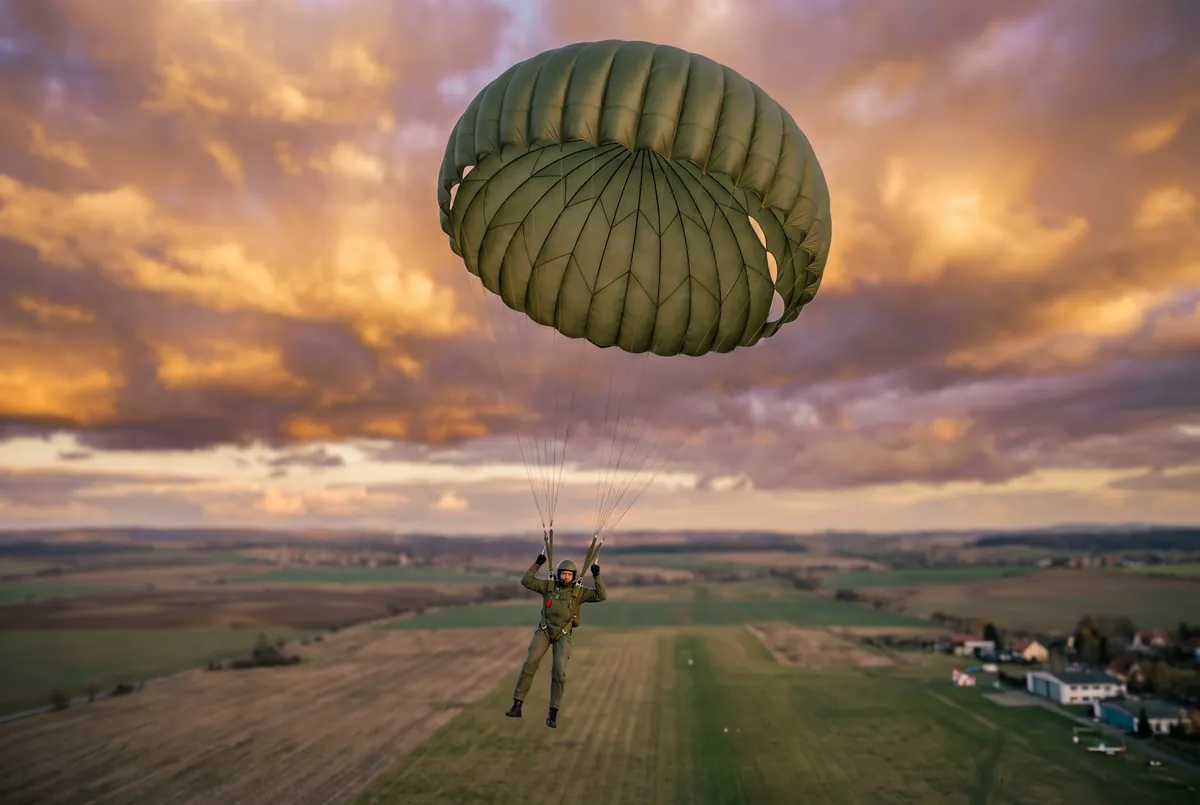
The MC1-1D is a US military round canopy derived from the T-10 family, designed in its MC1-1 version for the US Army in 1988. The canopy has a diameter of 10.7 m and 30 suspension lines; cut-outs in 11 gores give a forward speed of around 2 m/s and a 360° turn in 8–9 seconds, so it can be steered and landed on a chosen spot. It is opened by a static line; on exit the line pulls out the canopy and you concentrate on body position and checking the canopy.
A round canopy descends more vertically and without the gliding touchdown of a ram-air canopy, which is why the landing is harder — not because the canopy falls fast. On the contrary, the MC1-1D has a low rate of descent, 4.5 m/s on average compared with 6.7–7.3 m/s for the older T-10; those who master the technique land on their feet. It is because of the harder touchdown that you learn the PLF (Parachute Landing Fall): you spread the landing energy across five points of the body and walk away unhurt. For capable people it is a matter of picking up the technique, not of long drill.
Who the airborne course suits
- You want military training and airborne preparation, not an adrenaline package.
- You want to jump alone on a round canopy — the same procedure a paratrooper goes through.
- You are preparing for service, a vetting process or a selection procedure where airborne training is an asset.
- You are a team (unit, company, club) and want to train together — the course opens from 6 participants.
- Drawn to sport skydiving on a ram-air canopy and a skydiving licence? Then AFF is for you — both are real training, they just lead to different places.
Airborne courses and dates Calendar
Sources: V-PARA-1, 6th edition (ÚCL, 2026) · V-PARA-2, 4th edition (ÚCL, 2024) · overview of ÚCL parachuting regulations · Mills Manufacturing: MC1-1C/D technical data sheet.
FAQ
What people ask us
Can I start with the airborne course without a tandem first?
Yes. A tandem is not a requirement — the airborne course starts from zero with ground school and you make your first jump on your own. (For AFF the regulation recommends a tandem before the course, but does not require it there either.)
Is a jump on a round canopy more dangerous than a tandem?
It is a different kind of risk. The canopy is opened by the static line, you descend slowly (4.5 m/s on average) and you have practised the landing on the ground. Safety rests on ground school and on the limits set by the regulation — wind up to 6 m/s, no more than three jumps a day, always a main and a reserve parachute.
Do I get a certificate after the course?
Yes, a certificate of completed training and the number of jumps. It is not the ÚCL skydiving licence — that is obtained as category A through sport training (25 freefall jumps and an exam).
What if the weather stops us jumping?
That is what the fourth, reserve day in the course is for; exceptionally a date runs over three days only. If it is not used up, or the date does not have one, you complete the jumps on another date.
Can I continue after the basic course?
Yes. The airborne page lists the follow-on variants: solo jumps and free fall, and a refresher course for those who have jumped before. If you want sport skydiving on a ram-air canopy, you continue via AFF at a skydiving school.