
Terms explained
TCCC and TECC: what the difference is
Two acronyms you meet at every tactical medicine course. Here is what they mean, where they came from, how they differ and what a person without medical training may actually use.
What TCCC is
Tactical Combat Casualty Care is the standard for treating a casualty in combat. It came out of the US special operations community in the 1990s from a simple observation: most soldiers who died in the field of preventable causes bled out from a limb. The classical hospital sequence, which starts with the airway, did not fit the battlefield. TCCC reordered it and put bleeding first.
Today NATO armies use it in one form or another, the Czech army included. Its defining feature is that it distinguishes phases of care — treating under fire is not the same as treating behind cover, which is not the same as treating during evacuation.
The three phases of TCCC
Care Under Fire. The shooting has not stopped. The only things worth doing are returning fire, getting the casualty out of the line of fire and putting a tourniquet on massive limb bleeding. Nothing else. The best first aid in this phase is ending the threat.
Tactical Field Care. The immediate threat is over. This is where the full MARCH assessment happens: airway, chest, circulation, hypothermia.
Tactical Evacuation Care. The casualty is on the way to a higher level of care. Monitoring, additional equipment and the handover come in.
What TECC is
Tactical Emergency Casualty Care is the civilian adaptation of TCCC. It exists because civilian paramedics, police officers and firefighters end up in situations that resemble a battlefield — attacks, mass casualty incidents, collapsed buildings — while the circumstances differ. In civilian life you treat children and elderly people, nobody is wearing body armour, and the legal framework is different.
TECC therefore works with the level of threat rather than the combat situation: direct threat, indirect threat, evacuation. For a civilian, a company or a security service, TECC is the more relevant frame.
MARCH: the sequence that holds it together
Both systems rest on the same aide-mémoire. MARCH is the order in which a casualty is assessed and treated, so that a rescuer under stress does not have to work out where to start:
M — Massive haemorrhage. Tourniquet, wound packing, pressure dressing.
A — Airway. Open it and keep it open.
R — Respiration. Chest injuries, chest seals.
C — Circulation. Signs of shock, rechecking bleeding already treated.
H — Hypothermia / Head. Keep the casualty warm, even in summer.
A layperson needs M, A, R and H almost in full. That is exactly why it makes sense to learn first aid along these lines even if you never go near a fight: at a traffic accident or a circular-saw injury the order is identical.
What a layperson may do
This is where it is easy to overstep. Some TCCC interventions are reserved for healthcare professionals — needle chest decompression, intraosseous access, administering drugs. A course teaching those to laypeople creates a problem for itself and for its participants.
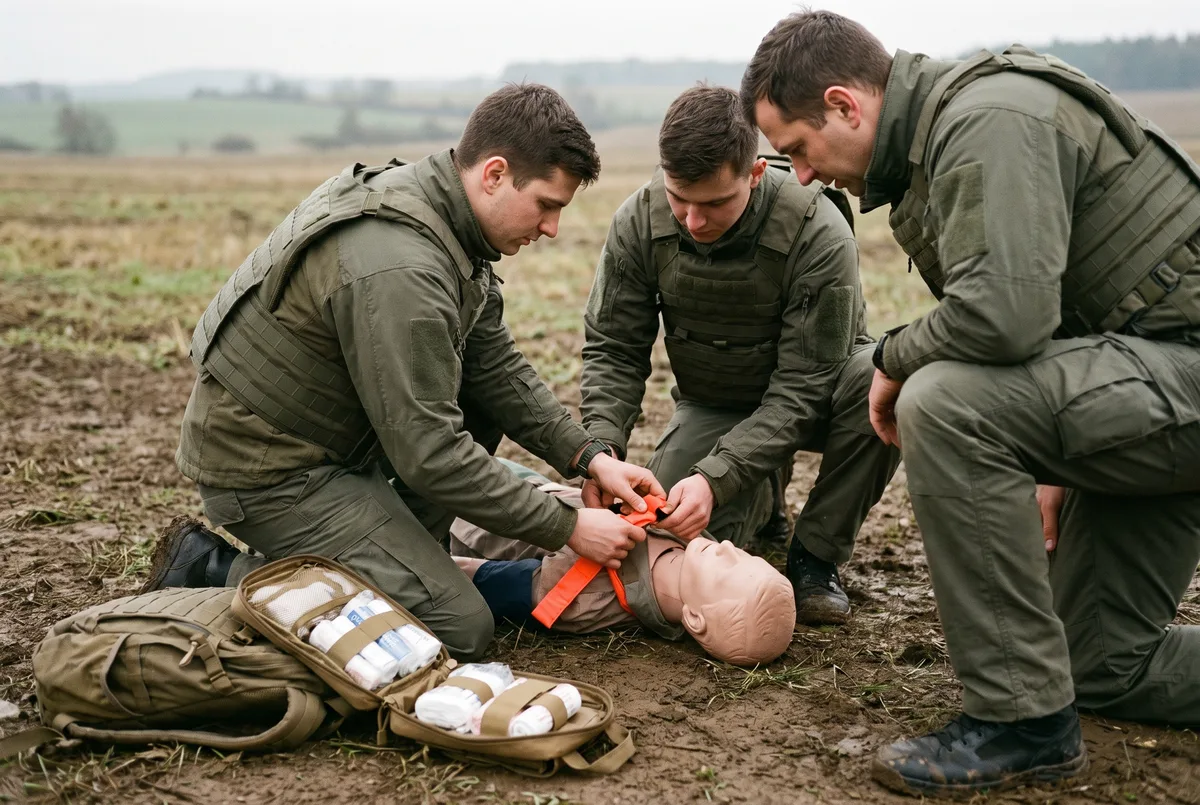
What a layperson may and should be able to do: stop massive bleeding with pressure, a pressure dressing, a tourniquet and wound packing, open an airway, use the recovery position, perform CPR, use an AED, apply a chest seal, prevent hypothermia and decide who to start with when several people are hurt. That is precisely what we teach.
Course tiers you will run into
Czech and foreign providers advertise acronyms worth telling apart:
TCCC-ASM (All Service Members) — the baseline tier for every soldier.
TCCC-CLS (Combat Life Saver) — a soldier without medical training given extended instruction, the link between the squad and the medic. Usually a multi-day course.
TCCC-CMC (Combat Medic / Corpsman) — for professional medical personnel.
TECC LEO / Provider — civilian variants for law enforcement and for paramedics.
Our courses do not belong to that certification system and we do not claim they do. They are built on the same protocols and teach them within the scope a civilian may use.
| TCCC | TECC | |
|---|---|---|
| Environment | battlefield | civilian settings, attacks, mass casualty incidents |
| Audience | soldiers and armed services | paramedics, police, firefighters, trained civilians |
| Phases | under fire · field care · evacuation | direct threat · indirect threat · evacuation |
| Casualty | adult soldier, usually with protection | anyone — children, elderly, unprotected |
| Sequence | MARCH | MARCH |
| What it gives you | the logic of priorities | the frame that fits civilian injuries |
Where to learn it
Knowing the sequence is worth nothing until you have had a tourniquet in your hands. Our medical courses run for one day and are built on exactly this logic: level 1 teaches life-saving interventions, level 2 multiple casualties and evacuation. They are taught by a practising emergency-care medic and Afghanistan veteran, in groups of no more than eight.
Frequently asked
What people ask
Is TCCC only for soldiers?
The protocols were written for the battlefield, but their logic applies anywhere help is not immediate. For civilian settings there is the adapted version, TECC. A civilian learns the same core from either: stop massive bleeding, open the airway, prevent hypothermia.
What does MARCH stand for?
It is the order of interventions: M for massive haemorrhage, A for airway, R for respiration, C for circulation, H for hypothermia and head. The point is that a rescuer under stress does not have to work out where to start.
What is the difference between TCCC and TECC in one sentence?
TCCC is the military standard for a casualty in combat; TECC is its civilian counterpart for accidents, attacks and multiple casualties. They share the MARCH sequence and differ in environment, type of casualty and legal framework.
Do I need a tourniquet as a civilian?
If you drive, visit a shooting range, work in a workshop or go into the woods, yes. A tourniquet is the only thing that reliably stops arterial bleeding from a limb, and it is also the one tactical medicine skill that has to work within seconds. Without practice people apply it far too loosely.
Does a tactical medicine course replace an ordinary first aid course?
It covers it and goes further. CPR, AED, choking, heart attack and stroke are part of our level 1 just as in any ordinary course; massive bleeding control, first aid kits and scenarios under pressure come on top.
Do I get a NAEMT certificate?
Not with us, and we do not claim otherwise. NAEMT is a US organisation that licenses its courses through authorised centres; several providers offer them in the Czech Republic at considerably higher prices. Our courses build on the same protocols, but we issue our own certificate of attendance.