
First aid that holds up under pressure
First aid and tactical medicine course
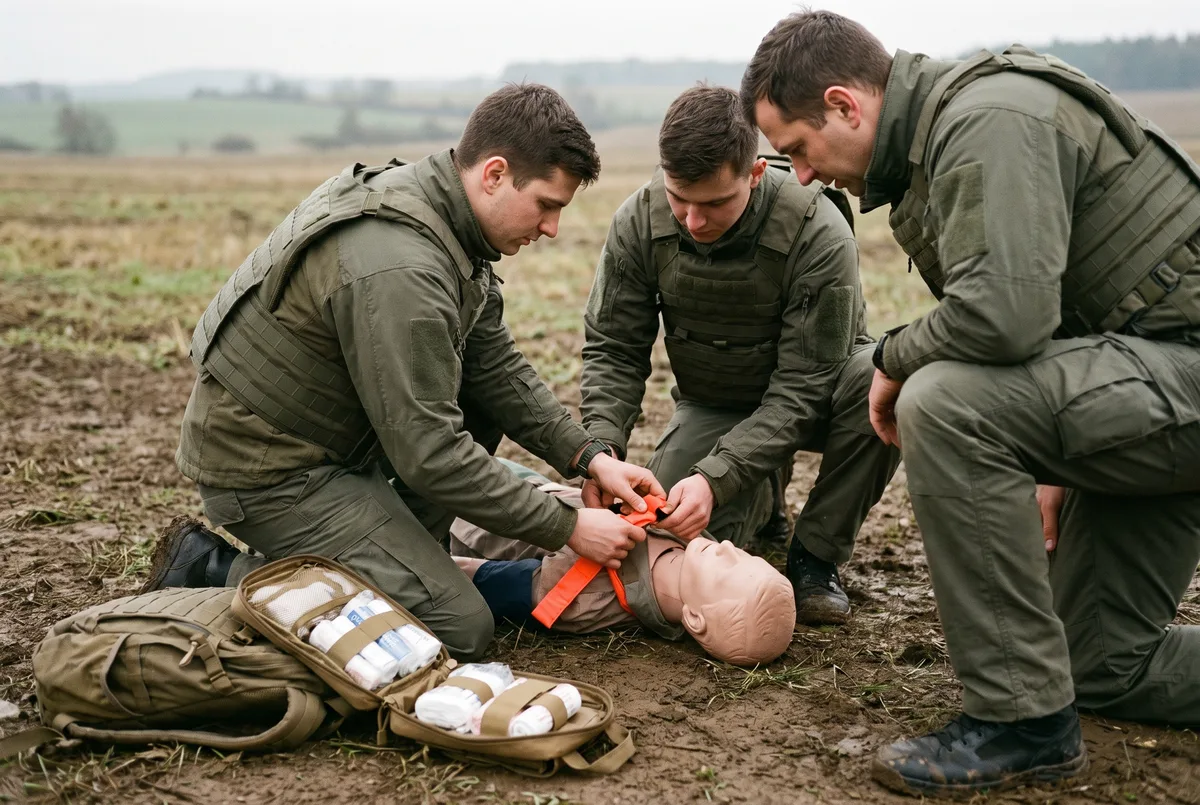
A one-day course near Znojmo for civilians, clubs and armed services, taught by a medic working in emergency care who served a tour in Afghanistan. We will show you how to stop massive bleeding, open an airway and keep a casualty alive until the ambulance arrives — drilled often enough that you will not have to think about it.
The skill you will not have time to recall
One of our courses that can save your life, or the life of someone next to you — at a traffic accident, at an injury on the range, in a workshop or out in the woods. Severe arterial bleeding is a matter of minutes, and those minutes belong to whoever is standing there. Not to the ambulance.
Our courses are built on tactical medicine — TCCC and its civilian counterpart TECC (what those acronyms mean). Those protocols were written for situations where help is not five minutes away and where you work with what you carry. The day is built around practice: most of it you are on a manikin or on a partner, and it closes with scenario work.
Who teaches the course
A medic with a university degree in the field. He works where the newest emergency-care protocols come out of front-line experience — so he knows them before they reach the textbooks. He is also a veteran of the Afghanistan deployment and holds the army instructor qualification for medical training. So he does not teach from a manual — he teaches what he does at work and what he did in the field.
We keep groups at eight people per instructor, the same ceiling the army keeps. That is not marketing: with more people you try a skill once instead of drilling it. For larger closed groups we bring a second instructor rather than a bigger circle around the manikin.
Level 1 — life-saving interventions
One day, 8 hours, no prior knowledge required. There is a single goal: that you do not freeze next to a casualty. You leave able to recognise and stop life-threatening bleeding, get air into an unconscious person, work out who to start with when two people are hurt, and hand over cleanly to the ambulance crew.
- Safety and the first minute. Scene assessment, emergency numbers 155 and 112 — what to say so that help arrives fast and in the right place.
- Massive bleeding. Direct pressure, pressure dressing, tourniquet (on yourself and on someone else, one-handed), wound packing, haemostatic dressing. Drilled until it is automatic.
- Airway and unconsciousness. Head tilt, recovery position, choking in adults and children.
- CPR and AED. Practice on a CPR manikin and an AED trainer.
- Chest, shock, hypothermia. Chest injuries and chest seals, positioning, keeping a casualty warm.
- Who to start with. At a traffic accident two or more people are hurt more often than not. We cover the basic triage rule here; level 2 develops it in full.
- The first aid kit. What is useless in a car kit, what is missing from it and what a usable IFAK looks like.
- Scenario work. Traffic accident, injury on the range, a fall in the field — the situations people actually meet.
Level 2 — multiple casualties and evacuation
The follow-up day for level 1 graduates or for people with a background (medics, soldiers, emergency services). Level 1 teaches what to do. Level 2 teaches what to do when there are three casualties and you have to get out.
- Repetition. The whole sequence again and at speed, until it holds.
- Care in harder conditions. On the move, in gloves, on the ground.
- Triage in full. Who first, who can wait, who is beyond help — and how you decide when the picture changes under your hands.
- Working in pairs, taking charge. Who does what, how to use bystanders, how to stay calm out loud.
- Improvisation. Tourniquet, splint and dressing from whatever is at hand when the kit is empty.
- Evacuation. Grips, drags, carries, improvised stretchers, moving a casualty over an obstacle.
- Handover to the ambulance. A short report: what happened, who is injured, what we did and when.
- Closing scenario. A longer continuous scenario with feedback and a debrief.
Prices
What it costs
| Format | Price |
|---|---|
| Level 1 — life-saving interventions 1 day, 8 hours, no prior knowledge | €120 |
| Level 2 — multiple casualties and evacuation 1 day, 8 hours, follows level 1 | €160 |
| Both levels together two separate days, booked at once | €260 |
| Closed group from 4 people, a dedicated date, price per person by level | as above |
| Refresher half-day 4 hours, graduates only, recommended after a year | €70 |
The price covers a full day of training, all medical and moulage material, the CPR manikin and AED trainer, a pocket card with the sequence and a certificate of attendance. We are not VAT registered, prices are final. We open a date from 4 bookings; if they do not come together, we offer another date or refund the fee.
Who it is for
Everyone has a legal duty to give first aid. Our courses are therefore not only for professionals — they are for anyone who does not want to stand next to an injured person and wait.
- Associations, clubs and groups. Hunting associations, volunteer fire brigades, motorcycle and cycling clubs — from 4 people we open a dedicated date.
- Gun owners and range visitors. A limb wound is handled only by someone who carries a tourniquet and knows how tight it goes.
- Hunters, motorcyclists, cyclists, paddlers and hill walkers. Anyone who spends time where the ambulance is far away.
- Armed and security services, active reserve. TCCC protocols within the scope a non-medic may use.
- Parents, drivers, teachers and group leaders. Civilian injuries make up most of the level 1 scenarios.
Closed groups
From 4 people we open a dedicated date for a closed group — a hunting association, a volunteer fire brigade, a club or a group of friends. We agree on the venue and shape the programme around what your group is most likely to run into. The day can be combined with shooting training, survival or team building — South Moravia is an hour from Brno and from Vienna.
How we differ from an ordinary first aid course
| Ordinary course | D&S Tactics | |
|---|---|---|
| Who teaches | a trainer following a syllabus | a practising emergency-care medic, army medical-training instructor, combat veteran |
| Share of practice | often most of the day in theory and slides | theory only as far as needed; the rest on a manikin |
| Bleeding | dressing and pressure point | tourniquet, wound packing, haemostatic — on yourself and on others |
| Equipment | one manikin for the whole group | a training tourniquet each, CPR manikin, AED trainer, moulage kit |
| Source of protocols | course syllabus | TCCC and TECC — tactical medicine standards |
| Group | 20 people and more | no more than 8 per instructor, the same as the army |
Straight up: we are neither an accredited medical course nor an internationally certified NAEMT course, and we do not teach procedures reserved for healthcare professionals. We teach what a layperson may do — and what saves lives most often. But it is taught by someone who knows that line from both sides.
Booking
Dates and booking
No dates are currently open. New dates are announced at the start of the calendar year and on a rolling basis — watch the calendar or drop us a line via the contact form and we will let you know.
Frequently asked
What people ask
How much does the course cost?
Level 1 costs €120 per person per day, level 2 costs €160. Both levels booked together cost €260. For a closed group of 4 or more we open a dedicated date at the same prices. We are not VAT registered, prices are final and include all medical material.
Who teaches the course?
A medic with a university degree in the field. He works where the newest emergency-care protocols come out of front-line experience, so he knows them before they reach the textbooks. He is also a veteran of the Afghanistan deployment and holds the army instructor qualification for medical training. So he does not teach from a manual — he teaches what he does at work and what he did in the field. We do not publish names or specific workplaces; instructor anonymity applies across all our courses.
Is the course suitable for complete beginners?
Yes. Level 1 assumes no medical education and no particular fitness. You learn what decides the first minutes: stopping massive bleeding, opening an airway, deciding who to start with, and keeping the casualty alive until the ambulance arrives.
How does it differ from an ordinary first aid course?
In the ratio of practice to theory, in who teaches it, and in the size of the group. Most of the day you are on a manikin or on a partner, and the day ends with scenario work. The protocols come from tactical medicine (TCCC and TECC), because they were written for situations where help is not five minutes away.
What do TCCC and TECC mean?
TCCC (Tactical Combat Casualty Care) is the military standard for casualty care in combat; TECC (Tactical Emergency Casualty Care) is its civilian counterpart for accidents, attacks and mass casualty situations. Both follow the same order: massive bleeding first, then airway, breathing, circulation and hypothermia. Our courses build on them within the scope a layperson may use.
Do I get a certificate?
You get a certificate of attendance with the date, the number of hours and the list of skills covered. It is a record for you, not for the authorities: not a ministry accreditation, not a NAEMT certification, not a substitute for medical education, and we do not issue it as documentation for public bodies.
How many of us must there be, and how many can there be?
We open a date from 4 bookings; the maximum is 8 participants per instructor. Eight is the ceiling the army keeps too, and we stick to it — with more people everyone merely tries a skill instead of drilling it. For larger closed groups we bring a second instructor.
Will you come to a closed group?
Yes. From 4 people we open a dedicated date for a closed group — a hunting association, a volunteer fire brigade, a club or a group of friends. We agree on the venue and shape the programme around what your group is most likely to run into.
What should I bring?
Clothing and shoes that may get stained with stage blood, and something to drink. All medical material — training tourniquets, dressings, haemostatics, a CPR manikin, an AED trainer — is ours and is included. If you own a first aid kit or IFAK, bring it; we will go through it and tell you what is missing.
Do courses run at weekends?
Yes. Medical courses are the only ones in our catalogue that we also schedule at weekends, all year round — they are not tied to the tandem jump season like the rest. The exact date is always in the calendar.
Can the course be bought as a gift?
Yes. The shop sells a gift voucher valid for one year from purchase. We can issue it either for an amount or directly for a specific course level; the recipient picks the date.